
Design Registration: Meaning, Scope, Requirements, and Global Protection
In today’s global and highly competitive marketplace, product appearance plays a critical role in influencing consumer choice. Beyond functionality, the visual identity of a product often determines its commercial success. To protect this visual creativity, intellectual property laws worldwide provide legal protection through Design registration. This form of protection safeguards the aesthetic features of products and grants exclusive rights to their creators.
This page explains the concept of Design, the meaning of an article, the purpose of Design registration, eligibility requirements, documentation, validity, exclusions, and international protection from a global perspective.
What Is Design?
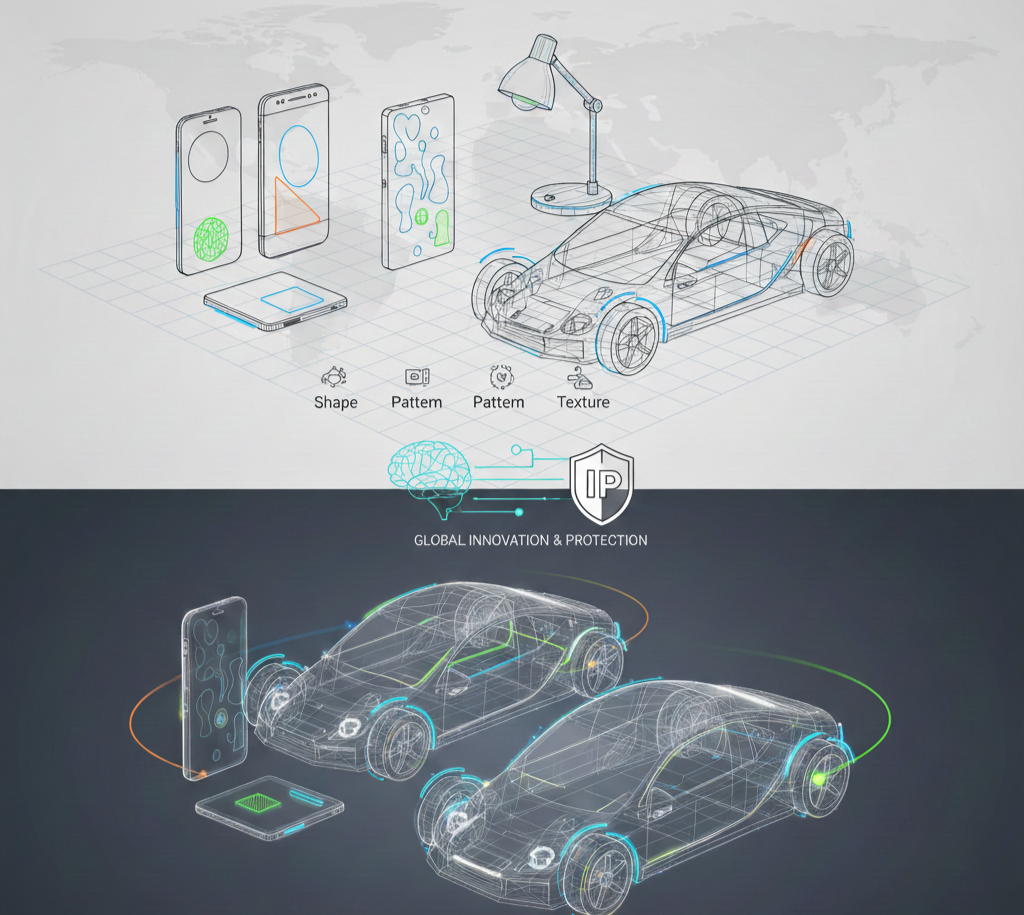
It refers to the visual features of shape, configuration, pattern, ornamentation, or composition of lines or colors applied to an article. These features may be expressed in two-dimensional form, three-dimensional form, or a combination of both. It may be created through manual, mechanical, chemical, or industrial processes, whether used individually or in combination.
The essential characteristic is that it must appeal to and be judged solely by the eye when applied to the finished article. It protects the aesthetic appearance of a product, not the technical or functional aspects.
Most of laws across jurisdictions exclude regarding this :
-
Methods or principles of construction
-
Purely functional or mechanical features
-
Trademarks or brand identifiers
-
Artistic works protected separately under copyright law
Thus, its protection is limited strictly to visual and ornamental elements
What Is an Article Under Design Law?
An article generally includes any manufactured product or substance, whether artificial, partly artificial, or partly natural. It also includes any part or component of a product, provided it is capable of being made and sold separately.
Examples of articles include consumer goods, furniture, packaging, electronic devices, textiles, fashion accessories, industrial equipment, and decorative items. Applied to an article must be capable of industrial application and reproduction.
Object of Design Registration
Every product is identified by two core elements: utility and appearance. While utility determines how a product performs, appearance influences how it is perceived by consumers. Many purchasing decisions are driven primarily by a product’s distinctive visual identity.
The primary objective of registration is to protect new and original visual features from unauthorized copying or imitation. Protection rewards creativity, promotes innovation, and encourages investment in product development. A registered also strengthens brand recognition and provides a competitive advantage in global markets.
Requirements for Registration of Design
Although procedures may vary between countries, the essential requirements for registration are globally consistent. A registrable must:
-
Be new and original
-
Not have been disclosed, published, or publicly used anywhere in the world before the filing or priority date
-
Be clearly distinguishable from known or combinations of known Designs
-
Not contain scandalous, offensive, or obscene material
If these conditions are not met, registration may be refused or later invalidated.
Who Can Apply for Design Registration?
Any individual, company, partnership, or legal entity claiming ownership of a new and original structure may apply for registration. The applicant may be the creator or a person or organization that has lawfully acquired rights in it.
Applications can be filed directly by the proprietor or through an authorized representative or agent. When filed through an agent, a Power of Attorney is typically required.
Documents Required for Design Registration
The documentation requirements are largely similar across jurisdictions and usually include:
-
Design application form
-
Clear representations or drawings of the article showing multiple views
-
Statement of novelty highlighting unique visual features
-
Power of Attorney (if filed through an agent)
-
Priority documents (for convention or international applications)
-
Disclaimer, if applicable
Accurate and precise representations are critical for defining the scope of protection.
Validity of a Registered Design
The duration of protection varies by jurisdiction but generally ranges between 10 to 15 years, subject to renewal. Most countries grant an initial term of protection, which may be extended by filing renewal requests within prescribed time limits.
During the validity period, the registered proprietor enjoys exclusive rights to use, license, and enforce the against infringement.
Functional Designs Are Not Registrable
A fundamental principle of Design law worldwide is that purely functional are not registrable. If the appearance of an article is dictated solely by technical or functional necessity and does not offer visual appeal, it is excluded from protection.
Such functional aspects may instead be protected, if eligible, under patent law.
Restoration of Lapsed Design
If a registered Design lapses due to failure to renew on time, many jurisdictions allow restoration within a limited grace period. The proprietor or legal representative must submit a restoration request along with the prescribed fee and supporting justification.
Upon approval, right are restored in accordance with applicable laws.
International Design Protection

For global protection, applicants may seek Design registration through national filings or international systems such as the Hague System for the International Registration of Industrial, administered by the World Intellectual Property Organization (WIPO).
Learn more about international protection here:
Link – https://www.wipo.int/hague
For general intellectual property guidance, visit:
Link- https://www.wipo.int
How Can Y&S Legal help you?
We feel happy to help you.
For free consultation please contact us.